
How to Choose the Right GPU Power for Your Fleet: From ATR to A330
Choosing the correct GPU power for your aircraft fleet is not just a technical decision, it directly affects aircraft safety, avionics reliability, APU wear, fuel burn, and turnaround efficiency. From regional turboprops like the ATR 42/72 to wide-body aircraft such as the Airbus A330 or Boeing 787, each aircraft type has a very different ground power profile and reacts differently to under- or oversupply.
In this guide, we look at GPU sizing through the lens of real aircraft families that appear in almost every fleet: ATR and Dash 8 on the regional side, A320 and 737 in the narrow-body segment, and A330 / B787 for long-haul. For each group, we explain what drives their electrical demand on the ground, which GPU ratings are typically used, and how to avoid common underpowered or overengineered solutions when planning new stands, hangars, or mobile GSE fleets.
GPU Power Fundamentals: Why Correct Sizing Matters
Aircraft electrical systems are extremely sensitive to voltage stability, frequency accuracy, and available load capacity. Most commercial airliners (A320, 737, A330, B787, etc.) require 115/200 V, 400 Hz three-phase AC on the ground, supplied via one or more 400 Hz connectors. Many turboprops, helicopters, and business jets additionally rely on 28 V DC for engine start and avionics. If the GPU cannot provide stable power at the required rating, you may see dimming lights, tripped breakers, nuisance fault messages, failed system checks, or in extreme scenarios damage to onboard electronics.
Oversizing is not harmless either. A GPU that is much larger than your real demand increases CAPEX, footprint, fuel or energy consumption, and maintenance cost. It can also run for long periods at very low load, which is sub-optimal for diesel engines and may result in fouling, wet stacking, and shorter service intervals. The correct GPU rating is always a compromise between maximum electrical demand, typical operating profile, safety margins, and future fleet evolution.
In practice, proper GPU selection should be based on three layers. First, the aircraft type data: what does the OEM specify for ground power (kVA, frequency, number of plugs, DC vs AC)? Second, the operational scenario: quick turnarounds with short connection time vs long MRO visits with all systems on, use in hot climates with heavy air-conditioning loads, or night-stop parking with minimal demand. Third, the infrastructure context: are you feeding only the aircraft, or also hangar tools, lighting, and PCA from the same GPU or PIT system?
Rather than asking “Which GPU does an A320 need?”, a better question is: “What is the peak diversified load for this stand or hangar when the A320 (or similar aircraft) is on ground, with realistic simultaneous loads?” Once that is understood, you can choose between typical GPU classes such as 30-45 kVA for regional turboprops, 60-90 kVA for narrow-bodies, or 120-180 kVA for wide-bodies, and then refine the final rating and redundancy concept.
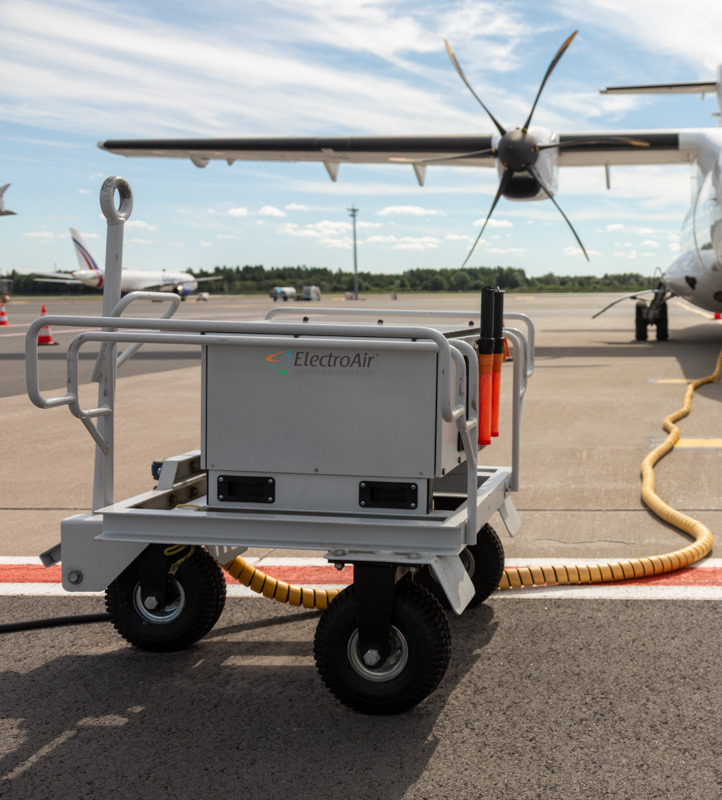
Regional Aircraft (ATR 42/72, Dash 8): Compact Aircraft, Real Power Demand
Regional turboprops such as the ATR 42/72 and Dash 8 family typically serve short sectors with fast turnarounds in a wide range of climates. Although they are smaller than jet airliners, they still carry full glass cockpits, navigation and communication suites, cabin lighting, galleys, and sometimes in-flight entertainment or Wi-Fi. During ground operations, these systems can draw a surprising amount of power, especially when combined with air-conditioning or de-icing preparation.
For ATR and Dash 8 aircraft, a typical 400 Hz ground power requirement falls in the range of 30–45 kVA for normal operation. This covers flight deck systems, cabin lighting, limited galley use, and environmental control support with a margin for transients. Some operators also use a separate 28 V DC GPU or combined AC/DC unit to support battery charging and engine start, particularly in colder climates where starting loads are higher and APU usage is restricted or costly.
Undersized portable GPUs are a common issue at regional airfields. When a 20 kVA-class unit is connected to an ATR during cockpit testing or when several loads come online at once, the GPU may struggle to hold voltage and frequency. Operators then see:
• noticeable voltage drops when pumps or fans start,
• intermittent avionics resets during maintenance checks,
• repeated APU start-stop cycles to “help” the GPU,
• increased stress on both ground equipment and aircraft components.
For MRO hangars handling regional fleets, it is usually more economical to install fixed 400 Hz points or PIT systems in the 45 kVA class, sized for worst-case maintenance loads and temperature conditions. Mobile diesel or battery GPUs can then be reserved for remote stands, outstations, or irregular operations, rather than being pushed to their limits day after day on every turnaround.
Narrow-Body Workhorses (A320, A321, Boeing 737)
The Airbus A320 family and Boeing 737 series form the backbone of global short- and medium-haul fleets. A typical single-aisle aircraft carries 150–230 passengers, several galleys, multiple lavatories, and a fully digital flight deck. Modern variants add high-power in-seat USB/AC outlets, cabin Wi-Fi, and more capable environmental control systems. All of this translates into a much higher electrical demand on the ground compared to regional turboprops, especially when the aircraft is being fully prepared for departure.
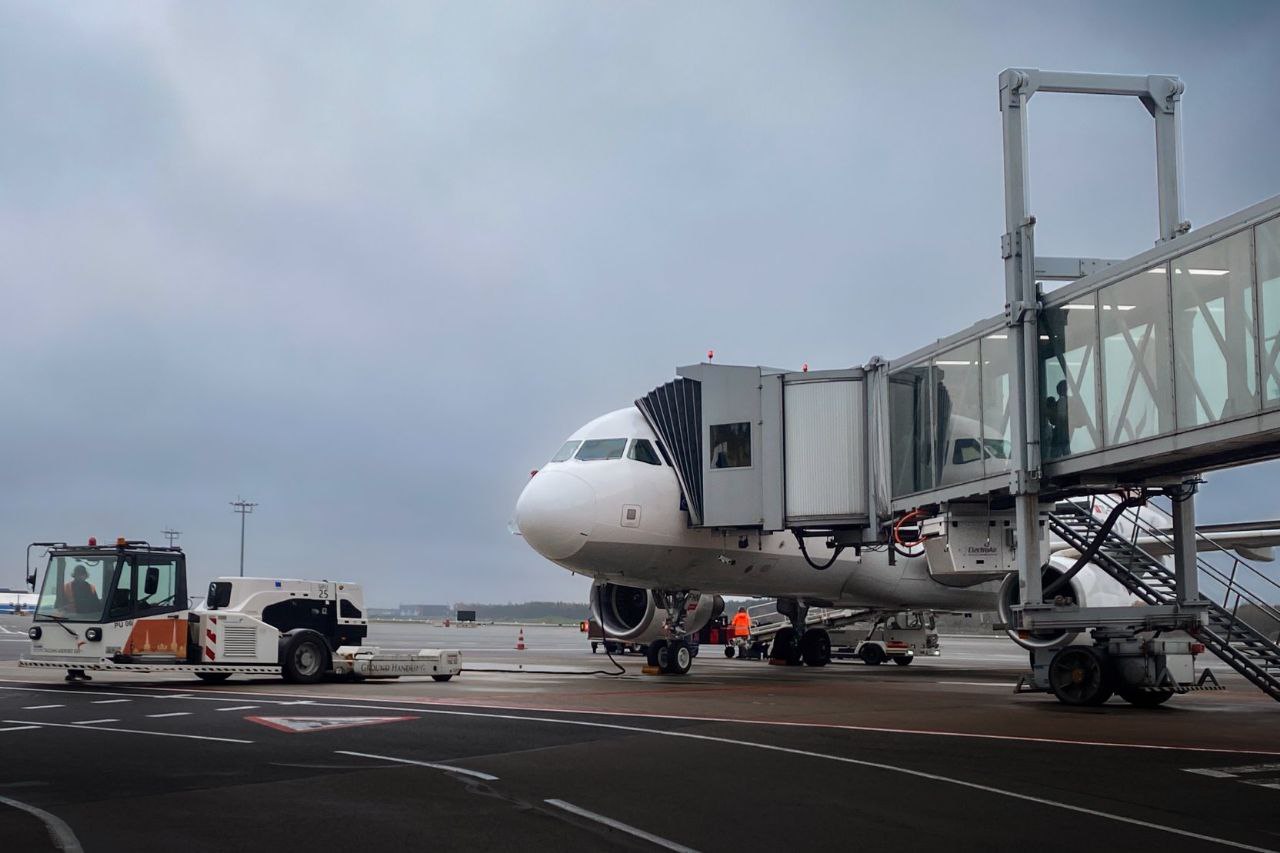
In most airport environments, the recommended GPU rating for narrow-bodies is a 90 kVA, 400 Hz unit per active power plug. This rating is designed to support simultaneous cockpit preparation, cabin lighting and cleaning, moderate galley use, cargo door operation, and air-conditioning support without frequent overload alarms. On gates where both GPU and PCA (pre-conditioned air) are taken from the same electrical backbone, it is important to consider whether the PCA load is supplied via the same GPU or a separate circuit, because PCA compressors can briefly draw as much power as the aircraft itself.
For mixed fleets dominated by A320 and 737 operations, 90 kVA has become a de-facto “universal” rating: large enough not to be a bottleneck, but compact and efficient enough for mobile units and bridge-mounted converters. Some high-utilisation hubs deploy two 90 kVA circuits per stand, allowing them to connect twin plugs for wide-bodies during peak hours while still serving single-aisles with only one cable connected the rest of the time.
When sizing GPUs for narrow-bodies, it is worth mapping a typical turnaround timeline: doors and lights on, cleaning crew boarding, catering and cargo operations, refuelling, boarding, and finally pushback. Identifying which loads overlap in time helps avoid both under-sizing (constant overloads and APU use) and extreme over-sizing (installing 120 kVA where 90 kVA would be sufficient for your real pattern).
Wide-Body Aircraft (A330, B787, A350)
Wide-body aircraft such as the Airbus A330, Boeing 787, and A350 are essentially flying data centres and hotels. A long-haul twin-aisle carries multiple galleys, several independent environmental control packs, high-density in-flight entertainment systems, powerful lighting, and extensive cargo hold equipment. During ground operations — especially during long turnarounds and overnight maintenance, many of these systems are powered from the ground, not from the engines or APU, if the airport has invested in proper infrastructure.
For this class, typical GPU demand lies in the 120-180 kVA 400 Hz window. In practice, this is often implemented as two or more 90 kVA outlets that can be used individually for narrow-bodies or in parallel for wide-bodies. An A330 on a hot-day turnaround with all galleys, IFE, and packs running can easily approach the upper end of this range. Newer composite aircraft like the B787 and A350 make extensive use of electrical systems (so-called “more-electric aircraft”), which further increases the importance of clean, stable ground power.
Airports serving wide-body fleets should not only think about GPU kVA, but about the entire stand architecture. That typically includes fixed or bridge-mounted converters at the passenger boarding bridge, PIT-fed distribution for nose or wing positions, redundant feeders from the substation, and digital monitoring so that energy usage and quality can be tracked per stand. The goal is to make APU-off the default mode of operation while still giving crews full comfort and system availability during long ground times.
From a planning perspective, it is often better to design wide-body stands for modularity and redundancy rather than a single oversized converter. Two 90 kVA feeders with the option to parallel them, plus a clear PCA strategy, will offer more flexibility over the life of the terminal than one very large unit that is either under-utilised or becomes a single point of failure.
Most Common GPU Sizing Mistakes
The most frequent engineering errors we see in projects worldwide rarely come from the GPU hardware itself. They usually arise from assumptions made early in design: “all ATRs are low-power”, “one rating fits all aircraft”, or “we’ll just use the APU if power is not enough”. These shortcuts tend to look acceptable on paper, but they quickly become expensive once real aircraft and crews start using the stand every day.
A typical mistake is selecting GPUs purely by aircraft type label, without analysing actual load profiles. For example, specifying “a 45 kVA GPU for ATR” might be fine for quick turnarounds in mild climates, but not for a maintenance base that frequently powers avionics, de-icing systems, and test equipment simultaneously. The same is true for A320/737: a 60 kVA unit may handle light operations, but if you expect full cabin conditioning and intensive galley use from ground power, a 90 kVA class system is far more appropriate.
Another source of trouble is ignoring non-aircraft loads such as PCA, hangar tools, lighting, or charging of other GSE from the same circuit. If you size a GPU only for the aircraft nameplate power and then add a PCA unit or several workstations to that feeder, you can easily run into overloads at the worst possible time, typically just before departure when everyone is using everything at once. Environmental factors (very hot or very cold days, high altitude airports) can also shift real power demand significantly compared to nominal values.
Finally, there is no allowance for future fleet changes. Many regional airports that once handled only turboprops now receive A320s and 737s; cargo stands originally built for narrow-bodies now see occasional A330 freighters. Designing a stand with zero growth margin in GPU power or cable capacity may look economical today, but it locks the airport out of future traffic opportunities or forces expensive retrofits. A modest buffer in kVA rating, combined with a modular architecture (e.g. dual 90 kVA feeders instead of one fixed unit), often pays for itself in the first few years of operation.
The cost of a wrongly sized GPU setup is not just technical; it directly affects APU usage, fuel burn, emissions, noise, and passenger comfort. When ground power is insufficient or unreliable, crews keep the APU running “just in case”, which increases CO₂ output and local NOx, undermines sustainability targets, and accelerates engine wear. Getting the GPU rating and architecture right from the start is one of the simplest ways to make your apron cleaner, quieter, and more efficient without changing a single aircraft in your fleet.
Need Help Selecting the Correct GPU Power?
ElectroAir engineers design GPU systems for mixed fleets worldwide, from ATR and Dash 8 turboprops to A320/737 narrow-bodies and A330/B787 long-haul hubs. We analyse your aircraft mix, apron layout, climatic conditions, and APU-off strategy to recommend a GPU power concept that works in real life, not just on paper.